Monday, March 21, 2016

Post 2: Modernism


Bibhu Mohapatra S-16 RTW: pastel print top & skirt.:
Modernism in today's society
Modernism can be described as a type of art that started in the beginning of the 1890s and ended in the first half of the 20th century like somewhere around the 1950s and 60s. As the "Guerrilla Girls" define it, modernism is "impressionism, postimpressionism, fauvism, cubism, futurism, constructivism, dada-ism, surrealism, expressionism, abstract expressionism, etc." put all together (GG, 59). 


Abstraction could be looked at as impressionism taken to the next level. Abstraction became about vibrant colors but its main focus was on geometry, Geometric shapes, forms, and distortions is what abstraction became all about. Women were very influential in pushing the abstractionism art movement. "The consolidation of Abstract Expressionism as the dominant practice in American modern art pushed to the margins not only women moving toward artistic maturity in other 'modern' styles during the 1940s, but also many women professionally active in what would come to be seen as 'conservative' and 'outmoded' figurative styles" (Chadwick, 319). Grace Hartigan, although her career as an artist practicing abstractionism, was "one of the first abstract women artists of her generation to earn an international reputation..." (Chadwick, 328). Hartigan's most famous work is from 1952 entitled, "Persian Jacket." Hartigan made a decision to give up abstraction because she felt as though her work was an imitation of male artists. Therefore, she left abstraction to find something more original. 
Persian Jacket, Grace Hartigan, 1952


Modernism especially German expressionism is an art form that is derived from the huge events that occurred during that time. This link: http://www.moma.org/explore/collection/ge/chronology highlights some of the major events like the Balkan Wars and WWI that occur during the German expressionism movement. Kathe Kollwitz is a famous woman artist that participated in German expressionism. Not many women were taken seriously when discussing politics but German expression was a very political type of art. Kathe painted but then shifted towards "graphic expression: prints, etchings, and lithographs" (GG, 70). 

Käthe Kollwitz. The Volunteers (Die Freiwilligen) (plate 2) from War (Krieg). (1921-22, published 1923)
Kathe Kollwitz, Wood carving on MoMA website

Hannah Hoch, according to the Guerrilla Girls, is known as "the mama of dada" (GG, 77). Dadaism is "an art movement that challenged every convention (except male supremacy) and scandalized bourgeois society" (GG, 66). Hoch is known as a dadaism artist but her works also included abstraction in her collages, photomontages, and other pieces. She had a relationship with a male artist, Raoul, and when that ended she was in a relationship with a female, Til Brugman. Like Kollwitz, Hoch's art was also very political as she focused on androgyny and lgbtq subjects, 
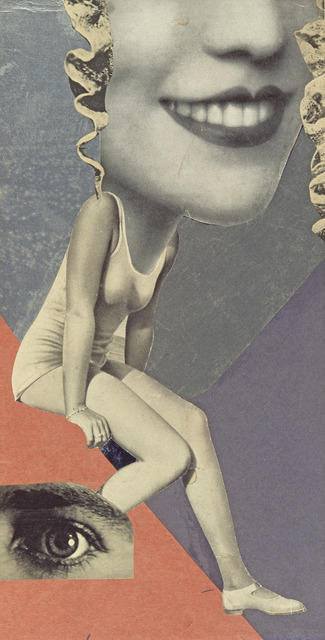

Hannah Höch, 'Für ein Fest gemacht (Made for a Party) ,' 1936, Whitechapel Gallery
Hannah Hoch, Made for a Party

Surrealism is a popular art form and http://www.theartstory.org/movement-surrealism.htm which provides a lot of information on surrealism mentions, "The Surrealist artists sought to channel the unconscious as a means to unlock the power of the imagination." Claude Cahun, like Hoch, expressed androgyny in her works of art. "Claude's sexual identity was so confounding that some books on surrealism list her as a man. Claude took pictures of herself in a range of gender-bending stereotypes..." (GG, 62-63). Her art was mostly in the form of photography. The fact that Cahun identified as a lesbian also made her surrealism political. Many of the male surrealists were homophobic and did not take surrealism to the next level as Cahun did. Her lesbianism was included in her works, "Instead of presenting herself as a passive object ready to be consumed by a heterosexual male gaze, she defiantly presents herself as both object and subject of her own sexual fascinations" (GG, 63). 

Claude Cahun, The Soldier with No Name
Works Cited

Chadwick, Whitney. 2012. Women, Art, and Society. 4th ed. New York, NY: Thames and Hudson.
Guerrilla Girls. 1998. The Guerrilla Girls' Bedside Companion to the History of Western Art. New York, NY: Penguin Books

Modernism


Modernism was a style which influenced art and architecture that dominated the Western culture from the 19th century up until the 1960’s. Women wanted to be be treated with equal rights in the different sectors of our male dominated society, especially in art. Modernism easily rejected the ideology of realism.The movements that were associated with modern art were Cubism, Dadaism, Surrealism, Impressionism, Futurism.It was revolutionary and created a big movement in the art world for men and women.
In Europe, many women were creating new ways of forming art. They persevered and eventually were acknowledged even though males were superior in the art industry.  One of the first women artists that influenced modern art was Georgia O’Keeffe. She used techniques from other artists, Paul Strand being one of those artists her close up paintings were influenced by. She used his method of cropping and painted American objects that were abstract and detailed. The Society for Applied Art in Munich involved artists, like Margaretha von Brauchitsch who’s embroidery designs gained attention at the World Exposition in Paris in 1900. She used nature and abstract designs in her work (Chadwick 253).Like many artists, Eva Hesse, was praised for feminine minimalist abstraction when she was close to her death. Being a women artist was taking a risk of becoming acknowledge after death. Since many women like Lee Krasner and Alma Thomas had to work harder than the male artists in their life to be taken seriously, they admitted that it was still worth it at the end because they did what they enjoyed.

Abstract expressionism was judged critically and challenged the boundaries in the art world in the 1930s. Artist Lee Krasner talks about how she had to  define herself as an artist to alleviate assumptions of her taking ideas or copying her husband, Jackson Pollock. Krasner and her husband once had an exhibition called “Man and Wife,” but the experience from the negative reviews was so disheartening that she destroyed most of those paintings and never held another exhibition. This shows just how much society had created this sexual difference in the art world. Making it so laborious for women to become successful artists.  Women were encouraged by their teachers to divorce the idea of art from female experience in order to be successful professionally (Chadwick 324). Art was a skill seen as acquired by men, because women were deemed uncreative. That is why Dorothy Dehner left her husband to become a professional sculptor. Most of the time men became successful but stuck to what they already knew. Women like Sonia Delaunay used the play of colors to express modernism( Chadwick 261). Her husband Robert Delaunay gained most of his success because of her innovative ideas.
Dadaism was a style that used shapes and simple objects. It did not express beauty but rather post World War I emotions. Dada performances broke down the notion that clothing was made to cover the body (Chadwick 274).Sophie Taeuber-Arp Vertical Horizontal Composition c.1916-18 shows the simple textile-like design she used and the colors of black,white,and gray to signify the world(Chadwick 273). Women’s fashion was also developing and becoming modern. Coco Chanel in 1910 invented the “little black dress” which became the hallmark of the 1930s. Many people started seeing these women as independent consumers and industrial workers. Women were moving past the boundaries they started with during the 20th century. The fashion and glamour of 1920s stressed the modern woman’s youth and sexuality and the reality of most women’s lives was far more complex (Chadwick 276).  


In modern art, the body of a woman was able to be painted without being sexualized. Throughout history, the male gaze has used female bodies for personal pleasure and objectified it.  Women were excluded from male dominated exhibitions and institutions until 1970. Suzanne Valadon’s painting The Blue Room depicts a woman in her natural state, not posing for anyone, but rather just relaxing like anyone else. This expressed the difference of nudes in Western art.She emphasized the awkward gestures of figures apparently in control of their own movements (Chadwick 285). This was contrary to the popular images throughout art that show women as controlled by the male gaze. Women started creating pieces of art using rags, fabric, thread, and flitter which associated with women’s cultural traditions. However, only certain materials and certain processes were honored instead of others (Chadwick 363).When women like Gina Pane climbed up and down a sharp ladder,depicting the struggle for women to climb up the ladder of success, it was ignored or labeled as a masochist by American feminist (Chadwick 367). Feminism actually developed as an international movement when women artists started questioning where to exhibit their work and finding space to work. Women inspired and developed new ideas in modernism in all sectors of art, including clothes, how they were perceived in society, and their abilities as human beings.  


 Links
Georgia O 'Keeffe-Life and art
Coco Chanel- Little Black Dress


Work Cited

Chadwick, W. (2012). Women, Art, and Society (5th ed.). New York, NY: Thames and Hudson.
Guerrilla Girls (1998). The Guerrilla Girls' Bedside Companion to the History of Western Art. New York, NY: Penguin Books

Post Two

   
Introduction to Modernism by Sadia Khalid
     Modernism is a period of art history lasting from approximately the late 1800s to the mid 1900s. During this time gender and sexuality were central to a lot of the work being done. In the late 1800s Baudelaire proclaimed that fashion was the focal point of this new art known as modernism. Fashion was complicated and conflicting. To Baudelaire, fashion encompassed the essence of humanity and it was this essence that was present in modern art. An artist must represent fashion in his or her art because fashion is key to humanity and represents it perfectly. (Chadwick, 252-25). Women were not treated with much more respect as artists. Men were still seen as the main breadwinners when it came to artistry. Nonetheless female artists continued to work away and produce art work throughout modernism. Criticism, sexism, patriarchy, and discrimination have been and continue to be major themes in the lives of female artists. (Guerrilla Girls, 59).

Vanessa Bell Cracow 1913

     A female voice that strongly influenced abstraction was that of Vanessa Bell. Bell painted a lot of oil paintings. Cracow, one of her most famous works, was derived from nature. She meshed abstraction and simplicity to create her artwork. It was created with wool and linen, showcasing the ability women have in the world of art. Like most successful female artists, Bell was worn into an upper class family and had a man help her gain some success as an artist. Though she is mostly forgotten by the world, even when she was alive, her work is considered on of the most influential of its time. Textiles had a big impact on her art and was used more often than not, which created a different vision than that of oil paintings. She fused pictorial language with ideas from Post-Impressionism. (Chadwick, 256-258).

Sonia Delaunay Prismes Isotiques 1914

     Dadaism was an art movement was at a point seen as unable to portray the modern world, dull, and materialistic. Sonia Delaunay changed that with her variant and liberal behavior towards her art. She combined art and craft and this combination attracted a new wave of dada artistry. The electric prisms painted in the painting above show how her vision turned her into one of the most influential artists of her time. (Chadwick, 272). Delaunay had her first art exhibit thanks to her husband. They discovered a theory of color, but her ended up taking the credit for the discovery. Once again we see the pattern of a young girl raised by a well off family finding her way to art, a life not possible for those of a lower class. A lot of art encompassed the the ideas connecting art and life. (Guerrilla Girls, 60-61). 

Louise Bourgeois Femme-Maison 1946-47
     Surrealism was a new an usual movement that occurred in the 20th century within art and literature. Its focal point was to express the ideas within the unconscious mind by any means necessary. There was a strong belief in repression and the need to unlock that repression through means of artistic motivation. Louise Bourgeois was strongly influenced by the surrealist movement during the 1900s. By allowing her work to become surrealists she happened across a new technique. She began to draw a lot of figures with the head of a house and the body of a female. These drawings depict how women are defined and how they are silenced. The domestic wife is one of the major ways to describe this type of work. The politics of gender is clearly seen in her work and the way her work is regarded by critics in a negative way. (Chadwick, 324).

Kate Kollwitz Self-Portrait, Hand at the Forehead 1910
     German expressionism is a form of expressionism that originated in Germany during the 1920s. It is associated with a huge peak in creativity before World War I. The female artists of the time were well aware of the gendered differences within the art world. The issue of "women can't paint" was faced head on by artists. The pressure between ideology and sex became very apparent within art made by both men and women. There was a lot on interest placed in the modern urban life. Women in this period did a lot of good work trying to break gender barriers within the art world through expressionism. (Chadwick, 279). Kollwitz was originally a painter, but eventually became a print maker a show of social activism. Most of her painting are all black and white. Due to the challenging circumstances in Europe around the time of World War I, she created art that showed directness and urgency. Kate made a huge impact as a German expressionist artist. She began to simplify her work as her time as an artist went on. She was the first female brought onto the Prussian Academy of Arts. Her work is very dark and suggestive of the major issues that went on during her lifetime. ("German Expressionism," n.d.)


Links:
German Expressionism

Works Cited:
Chadwick, W. (2012). Women, Art, and Society (5th ed.). New York, NY: Thames and Hudson.
"German Expressionism." MoMA.org. N.p., n.d. Web. 21 Mar. 2016.
Guerrilla Girls (1998). The Guerrilla Girls' Bedside Companion to the History of Western Art. New York, NY: Penguin Books.

Saturday, March 19, 2016

MODERNISM


Western art Modernism includes, but is not limited to, abstraction, German expressionism dada-ism and surrealism during this era 1910-1925. These 'isms' were all representations of political statements in art, and were an opportune way for females to portray their thoughts and feelings on political issues in a time of oppression, pre/post world war I.

Dada artist. German born, Hanna Hoch was among the first artists to work in photomontage, after World War I. “Cut with the Kitchen Knife Dada Through the Last Weimar Beer-Belly Cultural Epoch in Germany" is a prime example of such works.

At the end of World War I Germany was left in a state of political unrest. The longstanding Weimar government had been replaced by communist and left wing party, the 'Spartasists.' During this transitional period, Hoch used this form of modernism to reflect her own opinions on political and social matters in such a time of chaos, particularly the very apparent differences in gender equality in the once male-dominated Weimer republic. Hoch uses vivid descriptives to name her piece, shown below. The terms 'kitchen knife' and 'beer belly' have been purposefully picked to illustrate this patriarchy.


Hannah Hoch on her Male Colleagues:

"They all desired this 'new woman' and her groundbreaking will to freedom. But they more or less brutally rejected the notion that they, too, had to adopt new attitudes. It was not very easy for  a woman to impose herself as a modern artist in Germany...most of our male colleagues continued for a longtime to look upon us as charming and gifted amateurs, denying us implicitly any real professional status."

(The Guerrilla Girls' Bedside Companion to the History of Western Art, 67)


By carefully selecting only particular paper clippings from newspapers, magazines,
advertisements and journals Hoch arranged them in such way that allowed her to portray her critical examinations towards her personal defiance to the male-dominated societys' views of womens oppression. 


Hannah Hoch - 'Cut with the Kitchen Knife'


O'Keeffe was another key artist in the modernism art movement and one which became widely successful. Her notoriety rose as one of Stieglitz's protégée during the feminist movement. Stieglitz was quoted shortly after her works were displayed at his 1923 gallery exhibition. "Women can only create babies, say the scientists, but I say they can produce art - and Georgia O'Keeffe is the proof of it."

(Whitney Chadwick, WOMEN, ART, AND SOCIETY, fourth edition, 306)

Post World War I there was a rapid decline in birth rates, much to the dismay women were confronted by a barrage of literature urging them to stay at home where, as mothers and homemakers, they became the perfect marketing targets for a new peacetime economy based on household consumption.

Popular depictions of O'Keeffe featured predominantly New York skyscrapers as well as single flowers. These works are were intensely personal statements expressed in the reductive language of early Modernism. As she rose to fame as an artist of great promise attitudes towards women became progressively more liberal in nature.

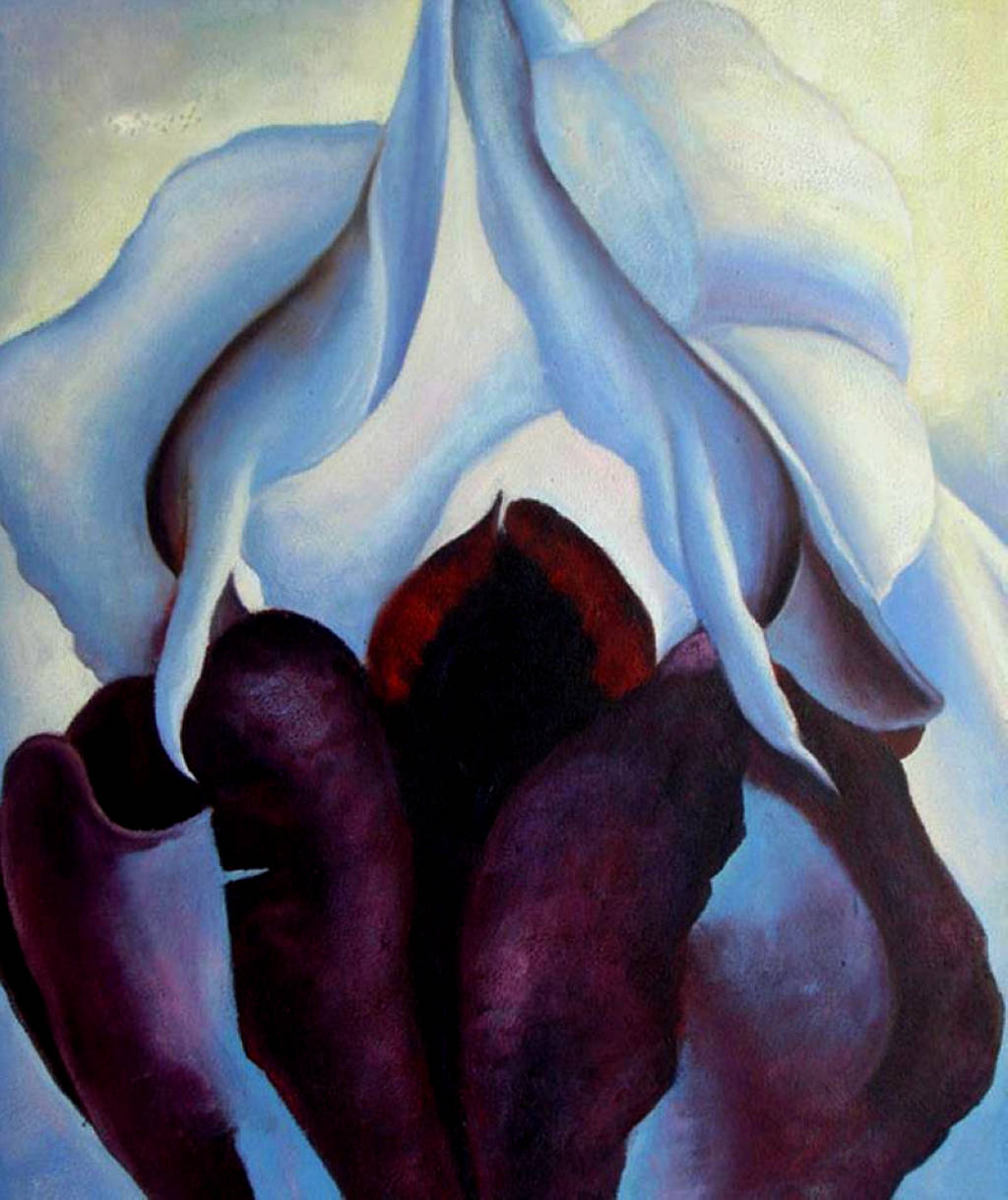
Despite being seemingly mundane objects and of which O'Keeffe detested, especially when it came to flowers "I hate flowers - I paint them because they're cheaper than models and they don't move!" she painted them because they were a perfect abstraction of the female libido in her art. 

"When a guy shows his libido in his art, its usually thought of as a noble gift to the world that is really about larger philosophical and aesthetic ideas. When a women shows hers, she's a sex-obsessed nymphomaniac.

(The Guerrilla Girls' Bedside Companion to the History of Western Art, 74)

Georgia O'Keeffe - 'Black Iris'

During the 1920's much of O'Keeffe's work turned to painting the skyscrapers of New York. These archetypical feats of the cityscape became an object of art work for many artists and photographers symbolizing economical growth and commercialism.

Georgia O'Keeffe - 'The American Radiator Building'


Sonia Delaunay, although equally an abstract artist, she varied quite significantly from artists such as Georgia O'Keeffe. Her work focused mainly on blocking colors and using bold, sharp lines and shapes to create various geometric patterns. As a result her work was favored for use on other popular mediums. Such examples included transferring her work to fabric, clothing, furniture, environments, cars, rugs & tapestries as well as costumes and sets for operas, giving the French economy a welcome boost.

By 1923 her most popular textile designs were commercially produced and widely seen as 'avant-garde.' This concept transformed the relationship between the bodies form and modern life by acts of unique individuals challenging unique ideologies to use images of the body as symbols for other kinds of social meanings. Delaunay reinvented the idea of  covering the body to use of the body as a fluid screen capable of reflecting and undergoing redefinition and transformation, giving light to personal expression.

"The Dress of today is the Industrial Dress. Fashion, which used to be the psychological reflection of everyday life, of customs and aesthetic taste, is now being replaced for a form of dress design for use in various forms of labor, for a particular activity in society."

(Popova's 1923 Essay)


Sonia Delaunay - 'Rythme'


http://hyperallergic.tumblr.com/post/4369997573/hannah-hoch-cut-with-the-kitchen-knife-through

http://www.museum-reproductions.com/cgi-bin/modern.pl?fid=1027464335&cgifunction=form

http://www.wikiart.org/en/georgia-o-keeffe/radiator-building

https://en.wikipedia.org/wiki/File:Sonia_Delaunay,_Rythme,_1938.jpg

Whitney Chadwick, WOMEN, ART, AND SOCIETY, Fourth Edition

The Guerrilla Girls' Bedside Companion to the History of Western Art, By The Guerrilla Girls


Friday, March 18, 2016

Modernism- Juleidy Aquino


Modernism was revolutionary during the 20th century. Women wanted to win equal rights in the patriarchal world of government, politics, society, employment, and most importantly, art. "In Western art, movements and "isms" appeared, one after another: impressionism, postimpressionism, fauvism, cubism, futurism, constructivism, dada-ism, surrealism, expressionism, abstract expressionism, etc." (Guerilla Girls, 59). All these extraordinary movements and new forms of expression revolutionized art and became known as modernism. 

Women in Europe were finding different ways of expression through many different types of art. Although men were still superior, women were firmly making their way through art. Through fashion, art and expression was able to take form. Margaretha von Brauchitsch, a craftswoman, focused her art on embroidery design in Munich that received notice in Paris, France (Chadwick, 253). The Omega Workshops in London was a place where women came together to express their ideas through design. Vanessa Bell designed dressed in the Omega Workshops that were "too exotic for the Omega's clientele" (Chadwick, 260). The colors and the way the clothes were organized and put together were very unordinary.

While these women were expressing art through fashionable apparel, Sonia Delaunay “designed book covers, posters, lampshades, curtains, cushion covers, and other objects for her home” (Chadwick, 261).  Although she was very talented in her work, her husband, Robert Delaunay, took her shine. However, together they developed simultanism, a theory of color (Guerilla Girls, 60). Sonia was very innovative while her husband basically stood to what he knew. She was always improving, and if it weren’t for her, her husband would not be as successful as he was.

When looking at their art side by side, you can see the differences and the depths both artists use to express themselves. The precision and brushstrokes are different. The stories both artists are telling are different. Also, the shapes used are totally different. However, side by side, you cannot tell the difference between which one was done by a female or a male.
Sonia Delaunay
Robert Delaunay
Dada was influenced by World War I and avant-garde movements. The art was not necessarily beautiful, but it was an expression of how society felt and the position the artists had. In a catalogue for an exhibition Jean Arp, an artists, wrote “These works are put together from lines, planes, forms, and colors. They are a reaction between human egotistical concerns” (Chadwick, 272). Jean Arp’s Paper Cut with Paper Cutter was not the ordinary art that was known to society. Her art expressed her not striving for perfection.

Example of Jean Arp's Art
Shapes and different materials were not the only things being modernized through art. The way a woman dressed in society was evolving. Nancy Cunard, had “adapted sportswear to daily life and capitalized on feminizing masculine fashion, posing in the “little black dress” that became the hallmark of 1930s fashion and was photographed by Man Ray” (Chadwick, 276). She wanted the “new woman” to be modern. Women also began to work industrial jobs and began receiving recognition for being independent and responsible after World War I.
Fashion and Art
The body of a women was also being recognized and modernized through art. “The difficulty of distinguishing between overtly sexualized and other forms of looking, the issue of female subjectivity and the identification of the female body with nature, generation, and the instinctual life have become important areas of investigation for contemporary feminism” (Chadwick, 282). A woman’s body was used throughout history for the male gaze and for the pleasure of men. Their bodies were sexualized and objectified in art. With modernism, women artists were able to take a woman’s body and draw or paint it in a normal state, with no sexualized expressions. Suzanne Valadon was able to present the female in their normal states “emphasizing the awkward gestures of figures apparently in control of their own movements” (Chadwick, 285). She painted women in their natural state and this art expressed the natural woman. Frida Kahlo also expressed herself through self-portraits. The pain that she endured in her life are all depicted through her paintings. It depicts women do have feelings and are powerful to overcome or deal with such feelings. It shows, once again, the normal life of a woman rather than an objectified and sexualized one.

Modernism was a combination of all “isms” throughout the history of art. Women revolutionized the way they were depicted, the way they dressed, the status they held in society, the difference in nudes and many more. The way women expressed different new forms of art revolutionized the way many women express themselves and dress today. Many men would not have received any inspiration or have adopted new techniques if it were not for women who pushed these innovations forward.

Attached below is a video on the timeline of modernism which makes it easier for one to under what is modernism and how has it affected art history and a video of Sonia Delaunay.

Modernism in Art

Sonia Delaunay
https://www.youtube.com/watch?v=61dz-2dL3Hc


Works Cited
Chadwick, W. (2012). Women, Art, and Society (5th ed.). New York, NY: Thames and Hudson.
Guerrilla Girls (1998). The Guerrilla Girls' Bedside Companion to the History of Western Art. New York, NY: Penguin Books.

Friday, March 11, 2016

Group 4: Impressionism

Our Presentation by Joshua Martinez, Laura Milad & Rajita Nayee:
https://docs.google.com/presentation/d/1AstfsKK1Y-BXoCWyjxbjNsM8myVUp-lhxTExs52j_zU/edit?usp=sharing

Our presentation was on Impressionism which originated in Paris during the 1860s. We researched artists like Mary Cassatt who was a very popular female impressionist artist. Who painted lots of everyday life paintings but it was her techniques that were most important. She never married because like some of the other artists we learned about she believed she would have to choose between having a family and having a career. Not wanting to give up her love for painting, Mary decided not to have children.
Breakfast-in-Bed.jpg
Breakfast in Bed

She befriended, Berthe Morisot whose painting was bought for the highest price a woman made painting has ever been purchased for. She was able to hold her first exhibit before her demise in 1895. She was at the center of Impressionism and inspired painters like Manet. You can watch the video on her we shared in class: https://www.youtube.com/watch?v=mupxAAjAiWM
The Cradle
The Cradle

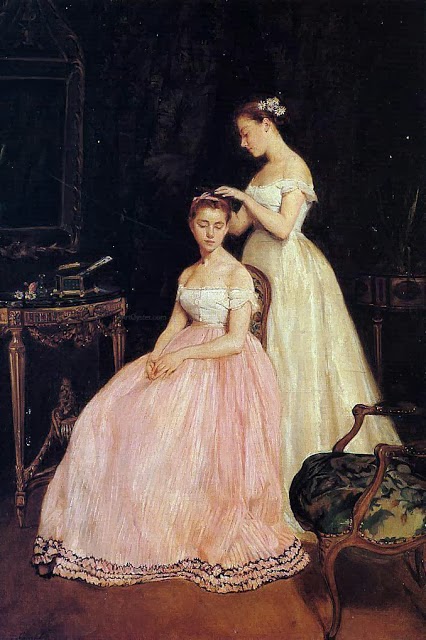
Eva Gonzales never exhibited with impressionists because of their controversial exhibitions in Paris but because of her painting style she is considered an impressionist. She wasn’t good at painting landscapes so she her paintings are usually mostly females. Below is a painting called La Toilette
Gonzalès , Eva La Toilette 1879.jpg

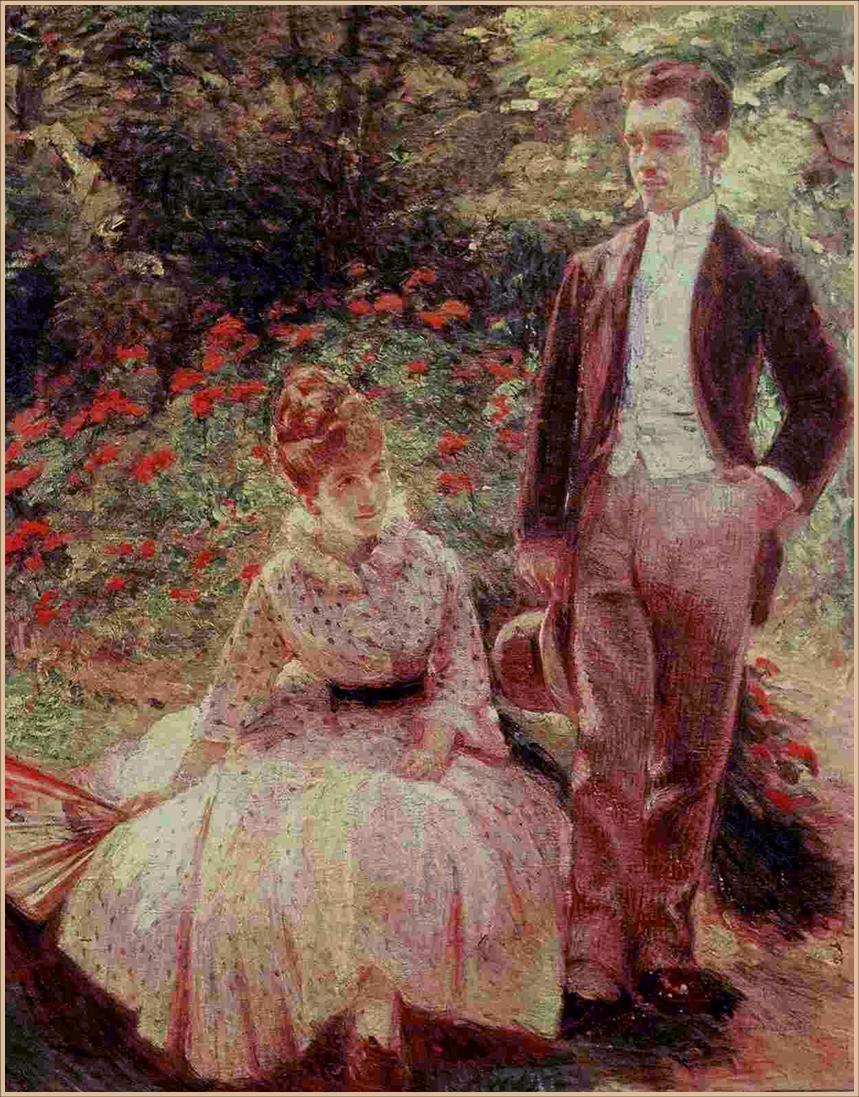
Marie Bracquemond admired artists like Monet and so as result she changed her style of painting. She took part of a impressionist exhibit in 1879,1880,1860. Even though she had support from her friends, her husband was against her expanding her career. She was confined to Sevres where she produced only a limited amount of work. Below you see, The Artist's Son and Sister in the Garden at Sevres (1890)

the-artist-s-son-and-sister-in-the-garden-at-sevres-1890.jpg

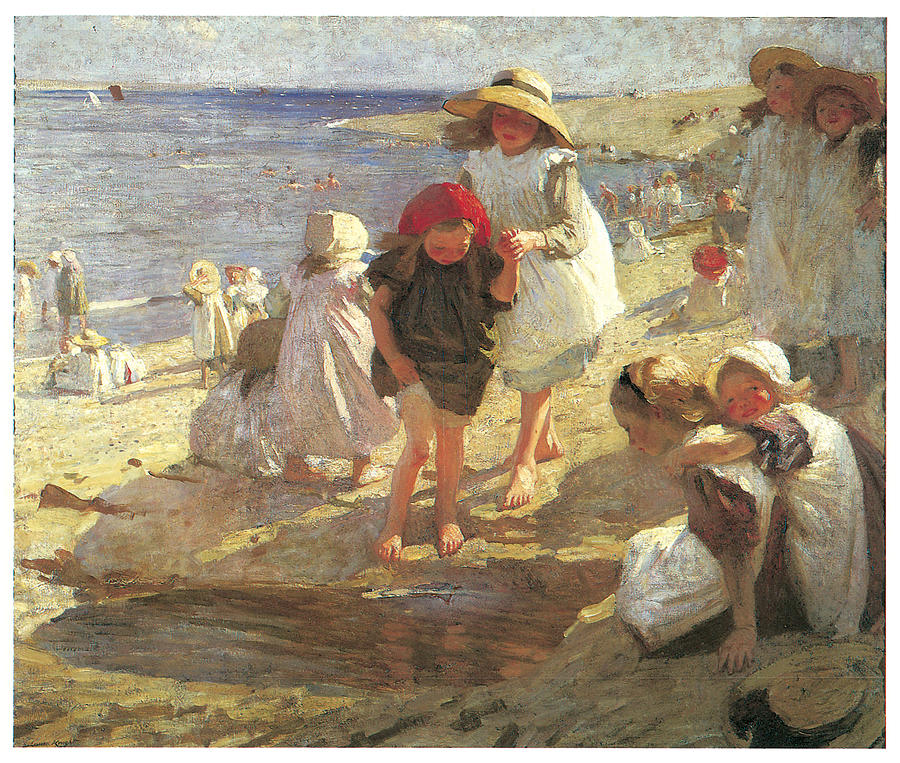
Laura Knight was the official artist at the Nuremberg Trials of Nazi war criminals. She also became the first female artist to be made a Dame and developed a passion for theatre and painted the most famous ballet dancers. Below is a painting named, On The Beach painted in 1909.
                               e2588fe963b8ad83f82aead83c14cf6d.jpg

Jane Peterson, During World War I, painted war-oriented subjects for the benefit of Liberty Loans and the American Red Cross. She has work exhibited within the Brooklyn Museum, Metropolitan Museum, & the Hirshorn Museum. You can see impressionist techniques in her painting shown below like the stairs, they look as if you would not be able to walk on them.
jane-peterson-san-remo-italy-1922-approximate-original-size-24x18.jpg
San Remo Italy

Sunday, March 6, 2016

Group One

Summary:
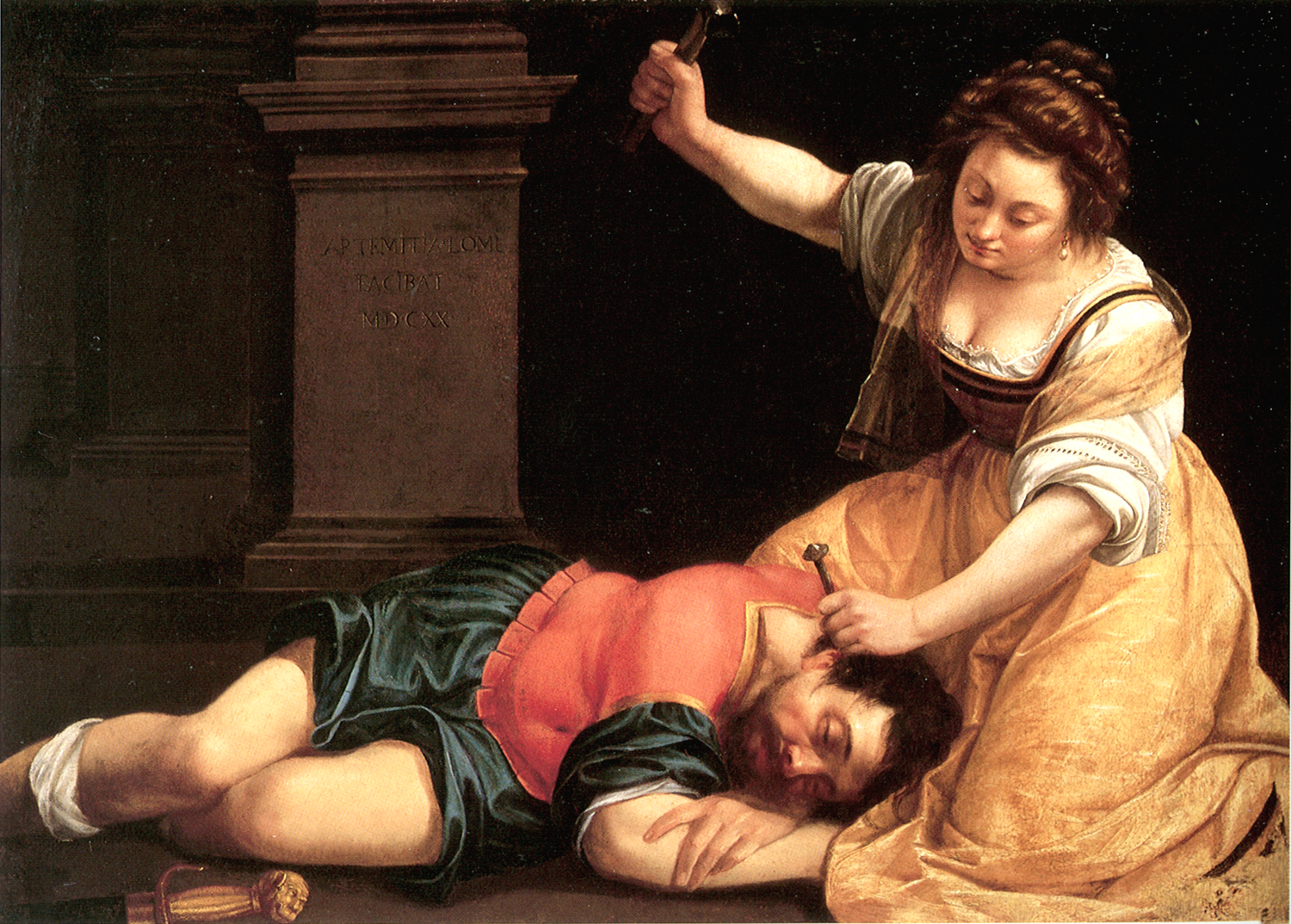
      Our presentation focused on why there were no "great" women artists during the Renaissance. Artemisia Gentileschi was known for her large and dramatic paintings of the female heroine in the context of the Old Testament, history, and mythology. Although being one of, arguably, the most famous artists of her time, she was forgotten by history after her death. It was not until Roberto Longhi in 1916 that she was truly rediscovered. Today Artemisia is finally recognized as one of the leading artists of her time. 
Elisabetta Sirani was a young artist that overcame the disadvantages females faced during her lifetime. She gained recognition and fought for her worth as an artist. Dianna Scultori was known for her engravings, which was uncommon for females at the time. She was one of the first female artists to sell art under her own name. Lavinia Fontana was a female artist that worked in the same social sphere as her male counter parts. Her paintings consisted of female nudes and she was the first Bolognese female to gain recognition throughout Italy.
Female artists have been just as “great” as men; the only difference between their works is the social construction of inequality. Women were given fewer opportunities from the start. Art was considered a man’s world. Elisabetta Sirani’s own father would not allow her to paint until a colleague encouraged him to allow her to pursue the life of an artist. The western male dominated viewpoint has been the only voice through which art history has spoken for a very long time. This viewpoint has consequently excluded females as “great” artists.

Question: What other social constructions have restricted women from becoming “great” artists?
Pictures:
Artemesia Gentileschi 


Elisabetta Sirani


Lavinia Fontana